Guest Series - 03 - Aromatic Biomarkers as Evidence of Late Palaeocene Tropical Rainforests in Southern India by Santanu Ghosh
Reconstructing ancient ecosystems requires proxies capable of surviving deep geological time. Among the most powerful of these are biomarkers, molecular fossils that retain structural information about their biological precursors long after the original organisms have vanished. In this study, aromatic biomarkers preserved in lignite from southern India provide compelling evidence for the expansion of tropical rainforest vegetation during the Late Palaeocene Epoch.
Why aromatic biomarkers matter
Unlike many biological signals that are erased during burial and heating, aromatic biomarkers are remarkably resilient. Their molecular frameworks can withstand diagenesis and much of the catagenetic pathway, allowing them to act as chemical archives of past vegetation and climate. While previous organic geochemical studies of Indian lignites have largely focused on saturated biomarkers, this work shifts the emphasis toward aromatic fractions, opening a more detailed window into palaeovegetation.
The Neyveli lignite record
Lignite samples from the Neyveli Basin (Tamil Nadu) were investigated as organic geochemical records of southern India during the Late Palaeocene. The aromatic fractions are dominated by pentacyclic triterpenoid derivatives, with minor contributions from diterpenoids. Crucially, many of these aromatic compounds can be traced back to angiosperm precursors, linking the molecular record directly to terrestrial plant communities.
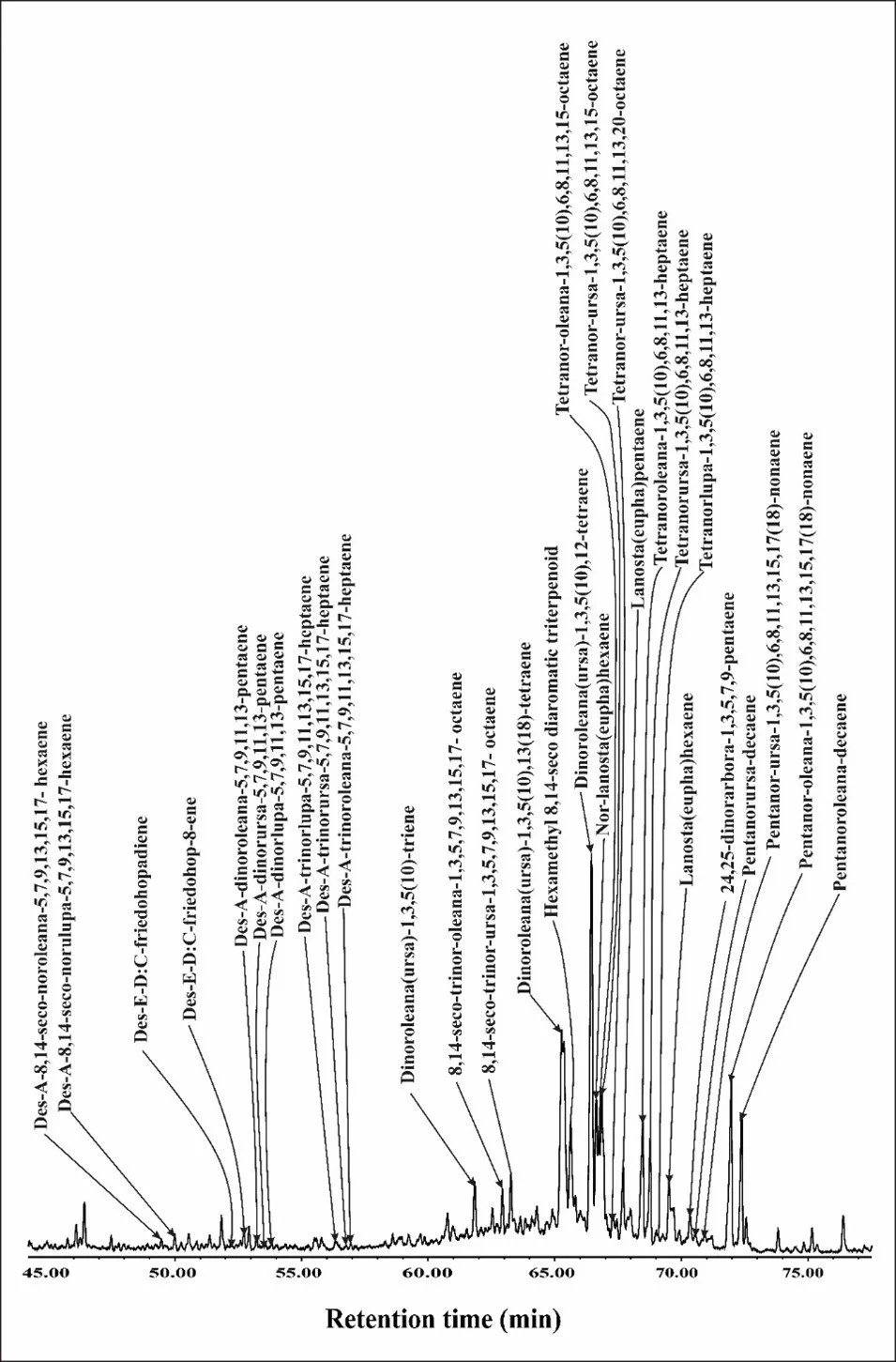
Representative aromatic triterpenoids in the studied lignite.
The presence of euphane- and tirucallane-type structures points to widespread angiosperm input. Further transformation products—formed through aromatization, ring cleavage, and microbial reworking—record the progressive alteration of plant-derived compounds during early diagenesis. Rather than obscuring the signal, these transformations preserve a chemical fingerprint of the original vegetation.
Tracing ancient rainforest lineages
Several aromatic triterpenes identified in the Neyveli lignites are consistent with biological precursors found in modern Betulaceae and Dipterocarpaceae. This is a critical observation. Dipterocarpaceae, in particular, are strongly associated with warm, humid tropical rainforest environments today. Their molecular signature in Late Palaeocene lignites therefore implies similar climatic conditions at the time of deposition.
Independent palaeoclimate studies support this interpretation, indicating elevated temperatures and high precipitation across the Indian subcontinent during the Late Palaeocene. The aromatic biomarker assemblage from Neyveli integrates seamlessly into this broader framework, strengthening the case for extensive Dipterocarpaceae-rich rainforests in southern India.
What this tells us about the Late Palaeocene
Taken together, the aromatic molecular fossils preserved in Neyveli lignite record more than just plant inputs, they document an ecosystem. They capture a period when southern India supported lush, angiosperm-dominated tropical rainforests under warm and humid climatic conditions. This study demonstrates how aromatic biomarkers can move beyond maturity assessment and source characterization to become robust tools for palaeovegetation and palaeoclimate reconstruction.
Why it matters today
Understanding how tropical ecosystems responded to past greenhouse climates is not just of academic interest. These records provide critical context for modern climate change, offering long-term perspectives on vegetation dynamics, carbon cycling, and ecosystem resilience. Aromatic biomarkers, quietly preserved in ancient coals and lignites, continue to speak—if we know how to listen.
This Guest Series contribution is based on the study “Aromatic Biomarker Evidence of Late Palaeocene Tropical Rainforest in Southern India” by Santanu Ghosh, Zoremsiami Pachuau, Ashutosh Panigrahi, Supriyo Kumar Das, Lalramengi Fanai, J. Malsawma, and Paul Lalnuntluanga.
About the author
Santanu Ghosh is a geoscientist and Assistant Professor at Mizoram University specialising in organic geochemistry and biomarker applications for palaeoenvironmental reconstruction. You can find more about his work via:
https://sites.google.com/view/santanughosh/home
https://scholar.google.com/citations?user=NlahoOEAAAAJ&hl=en
https://www.researchgate.net/profile/Santanu_Ghosh22
Contact Santanu Ghosh at gsantanu@mzu.edu.in
