Guest Series - 04 - Expect the unexpected: Serendipity in coal research by Jim Hower
In looking back at the beginnings of a research path, it might be convenient to attribute the origins to a well-planned hypothesis. Such are the stories we tell ourselves, but in my 50 years in coal science, I find that hypotheses can be the afterthoughts of divergent paths, the inspirations from unexpected sources, and the convergence of seemingly niche areas of research with, as discussed here, emerging critical resource demands. In disjointed bits and pieces, this is the story of our research in critical elements, particularly the rare earths (REE), in coal and coal-combustion fly ash.
In 1990, along with Cortland Eble (Kentucky Geological Survey), we set out to sample the Fire Clay coal, one of the most important resources in eastern Kentucky. Based on previous studies, it was well established that the coal seam contained a volcanic ash-derived tonstein containing monazite, apatite, and zircons. The connection between the tonstein mineralogy and a significant concentration of REE in the tonstein and in the coal adjacent to the tonstein was not seriously considered until Jingle Ruppert (US Geological Survey) analyzed several lithotype suites of the coal seam and found interesting, if not significant, amounts of REE (Hower et al., 1999).
Starting in 1992, the Center for Applied Energy Research (CAER) asked me to conduct pent-annual surveys of coal-combustion products from coal-fired power plants in Kentucky. The surveys included collection and chemical analysis of the feed coals, fly ash, bottom ash, and flue-gas desulfurization products. Unfortunately, the CAER’s analytical scheme at the time did not allow for the routine analysis REE. We could analyze mercury in coal and fly ash, though, and, thus, were able to be active players among the US researchers seeking to understand Hg occurrences in coal and fly ash and to control its atmospheric emissions. In 2001, in an attempt to more thoroughly examine Hg partitioning in fly ash, along with undergraduate student Sarah Mardon, we arranged for a 200-MW power plant to burn a single coal seam from a single mine for a few days so that we could sample the ash from that burn (and sample the coal at the mine). The Hg, Fire Clay coal, and REE studies accidentally merged when the coal, a correlative of the Fire Clay, turned out to have high REE and the fly ash had +/-1500-ppm REE (Mardon and Hower, 2004). The latter paper, along with Hower et al. (1999), got attention in the early 2010’s when the US Department of Energy (DOE) and other agencies were starting to see the need to develop domestic supplies of critical minerals from conventional and unconventional sources.
More intensive examinations of REE, much of it funded by the DOE, including fly ash beneficiation done by Jack Groppo (University of Kentucky CAER and Department of Mining Engineering) and work with Physical Sciences Inc. and Winner Water Services on the pilot-scale extraction of REE from fly ash, continued through the 2010’s and early 2020’s (Hower et al, 2020, 2021). On the geology side, we collaborated with Shifeng Dai, Vladimir Seredin, Colin Ward, and many others.
The small sampling scheme to sample the Fire Clay coal was not envisioned to continue for nearly three years, resulting in more than 400 coal and rock samples, much less lead to an improved understanding of the REE concentrations in that coal. The coincidence of the Hg-partitioning study also serving as a lesson in REE distribution was serendipitous. Both studies provided the preparation and scientific basis when world events required the US and many other countries to broaden their supply lines of critical minerals.
Geologists learn to expect the unexpected . . . so much of what we study remains out of sight, hidden at depth or within the mountain. Expecting the unexpected likewise teaches us to be prepared to make the most of those serendipitous discoveries, some of which can provide the basis for decades of research.
References cited
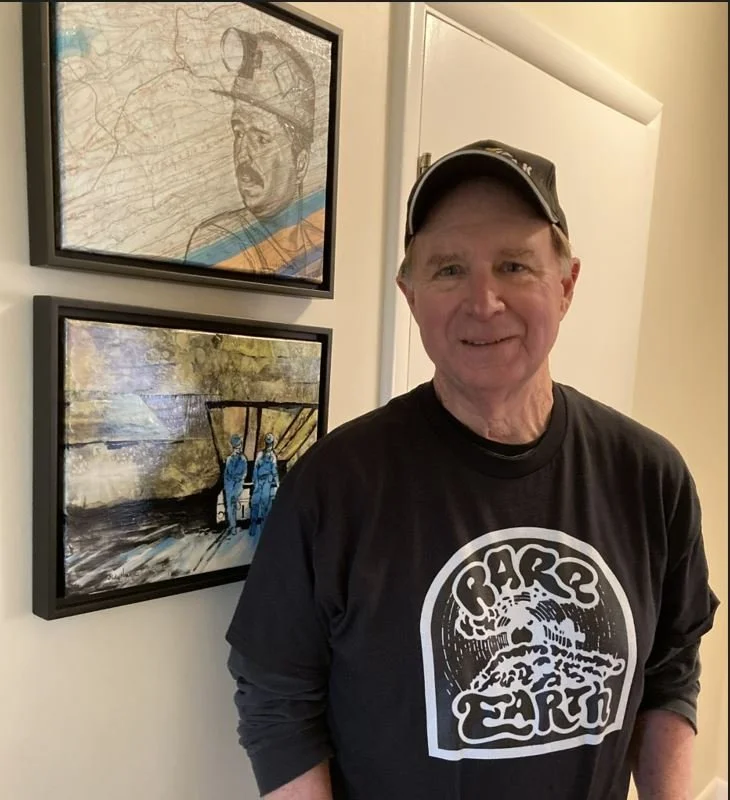
About the Author
Jim Hower received his BA, MS, and PhD degrees in geology from Millersville University, Ohio State, and Penn State, respectively. He has been a scientist at the University of Kentucky’s Center for Applied Energy Research (CAER) since 1978 and has been an adjunct professor and, later, a Research Professor in the University of Kentucky Department of Earth & Environmental Sciences since 1981 with a research focus on a broad range of topics within coal and fly ash petrology and chemistry. As of mid-2021, Jim retired from the university, but, finding that retirement is a speedbump and not a wall, he remains active at the CAER and elsewhere. He has authored more than 575 papers in more than 140 journals and books. He was the editor of International Journal of Coal Geology and Coal Combustion & Gasification Products for 10 years each. Jim has received the top awards from The Society for Organic Petrology, International Committee for Coal & Organic Petrology, and the Geological Society of America’s Energy Geology Division. In addition, he was a fictional coal geologist in Karen Rose Cercone’s 1999 mystery novel, Coal Bones.
https://www.linkedin.com/in/james-hower-819b3b16/
https://uknow.uky.edu/professional-news/caer-s-hower-co-authors-pioneering-coal-book
https://www.amazon.com.au/Coal-Bones-Karen-Rose-Cercone/dp/0425166988
