The Society of Reflective Personalities - Corpogelinite
The Unit
Personality:
Nobody asked them to stay. Nobody needed to. The Corpogelinite Unit does not abandon its post.
They operate in two divisions.
The Perimeter Unit was posted at the frontier — the outer wall, the first line, the boundary between order and everything that wanted in. Their assignment: Seal, Protect, Resist. Together with Suberinite, they held that edge. They took it seriously then. They take it seriously now. The fact that what they were protecting has been gone for hundreds of millions of years is, in their professional assessment, not a reason to stand down. They are still at their posts.
The Rapid Response Unit operated in a different location. When injury struck or a pathogen breached, they were deployed. Fast, purposeful, amorphous until needed and then suddenly, precisely placed — blocking spread, sealing the breach, containing the damage. They set. They held. Telinite and Resinite regard them with affection. Together, they defended and kept the structure intact.
Both divisions are always found in numbers. That is non-negotiable. A single corpogelinite is a liability, a gel gone rogue, and left to Collotelinite or Collodetrinite to deal with them.
Under the microscope they appear rounded, discrete, smooth-outlined, and utterly unbothered. Compact. Self-contained. Their uniforms are impeccable. Their posture is upright. Their belts are tight — or at least, they were, before geological time made certain adjustments to the senior officers.
And then there are the others. The Infiltrators.
They sneak in later. They wear the same uniform. They hold the same positions. They use the same terminology. Their outlines are smooth, their bearing is correct, and if you ask them directly, they will tell you — with complete conviction — that they have always been here.
The senior officers do not believe this. But after hundreds of millions of years of surveillance, they have found no evidence, filed no formal report, and reached no conclusion. The suspected infiltrators continue to stand at their posts, indistinguishable from the originals, utterly unbothered by the scrutiny.
Collotelinite finds them baffling. She respects discipline. She does not entirely understand why they are still guarding something that no longer exists, breaking from time to time through her immaculate surface. The senior Rapid Respond officer, when informed of this observation, straightened his belt and replied:
"With respect, ma'am. That is not your concern."
The Corpogelinite Unit outlasts the post.

Scientist’s Note:
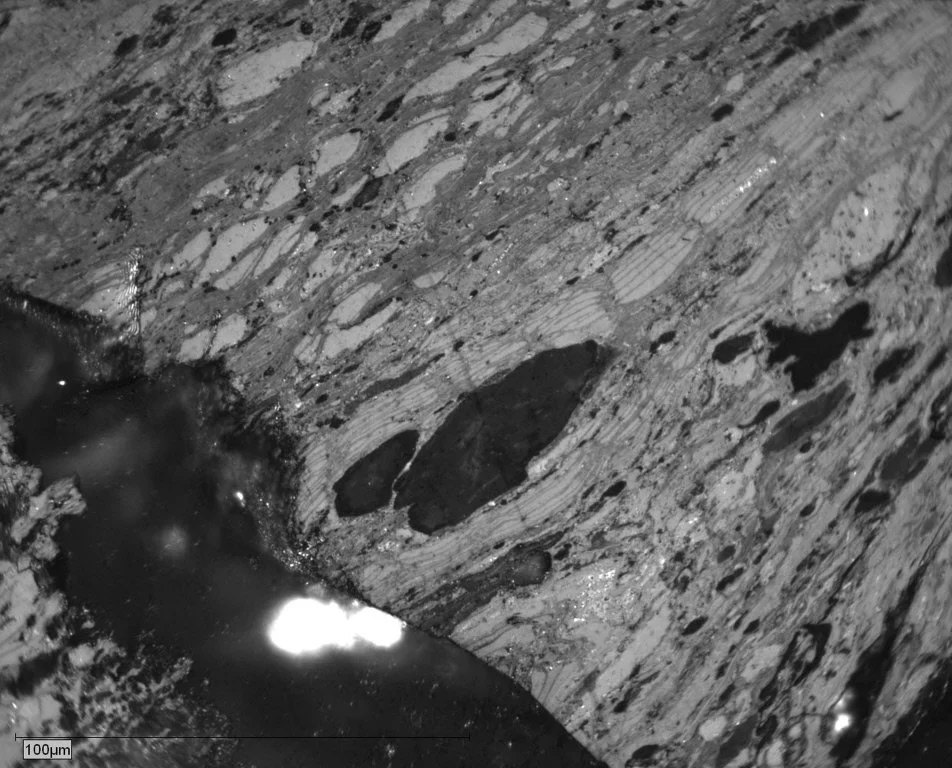
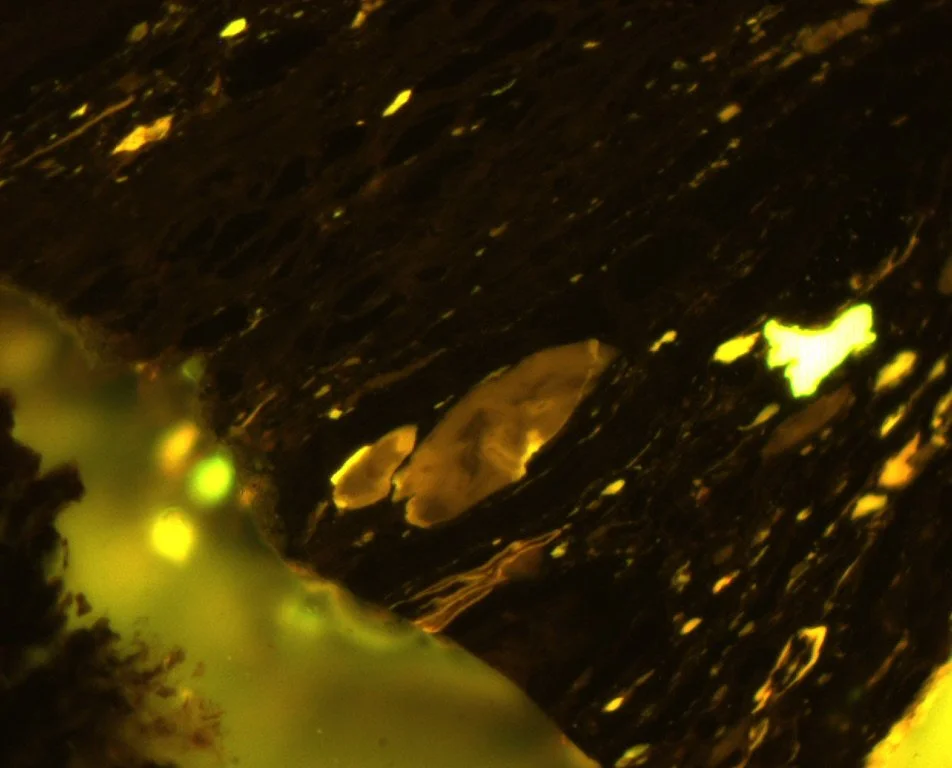
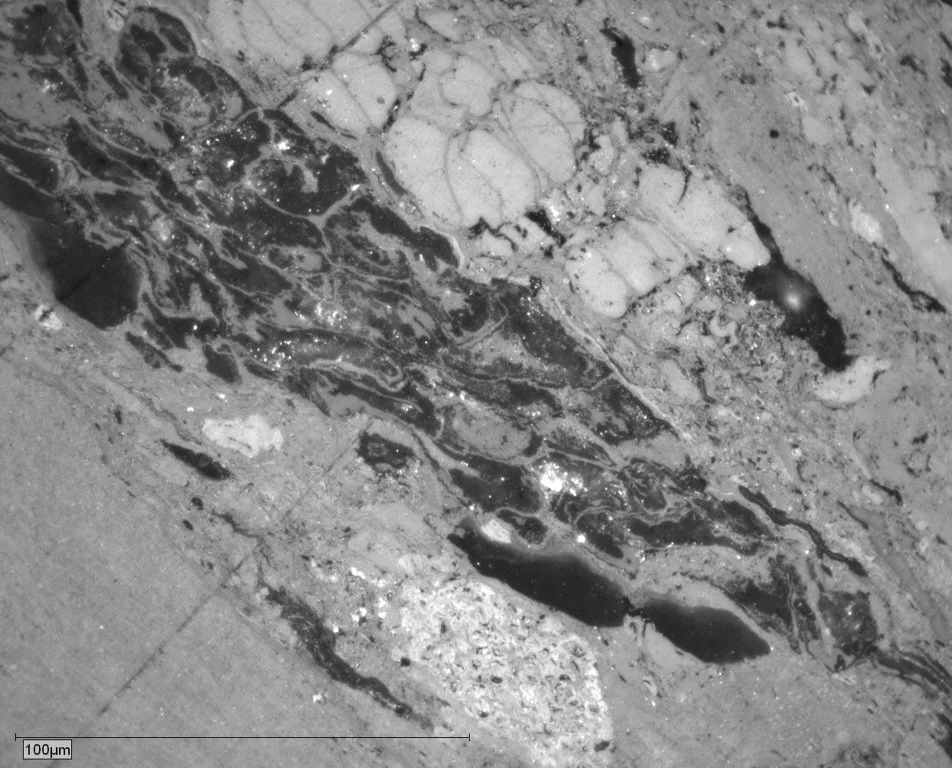
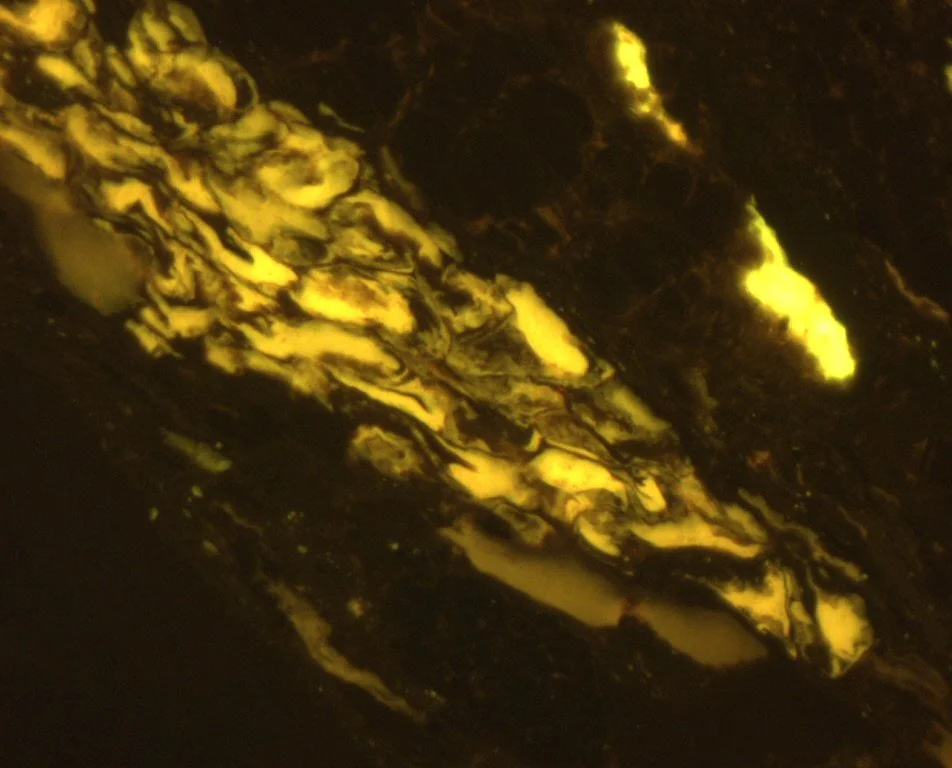
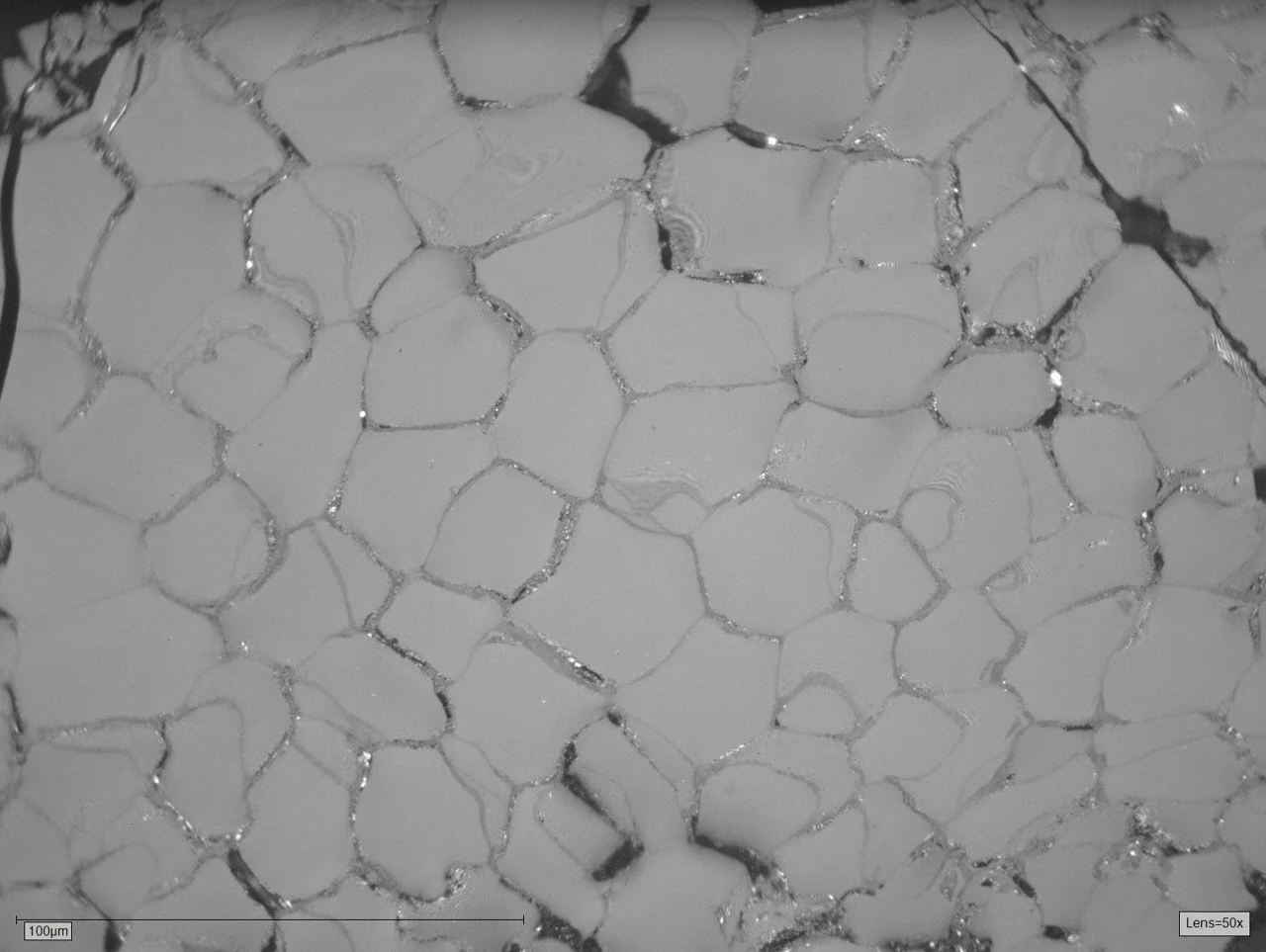
Corpogelinite is a maceral of the gelovitrinite subgroup within the vitrinite maceral group. It consists of homogeneous, structureless vitrinitic material occurring as discrete bodies, most commonly as infilling of cell lumina.
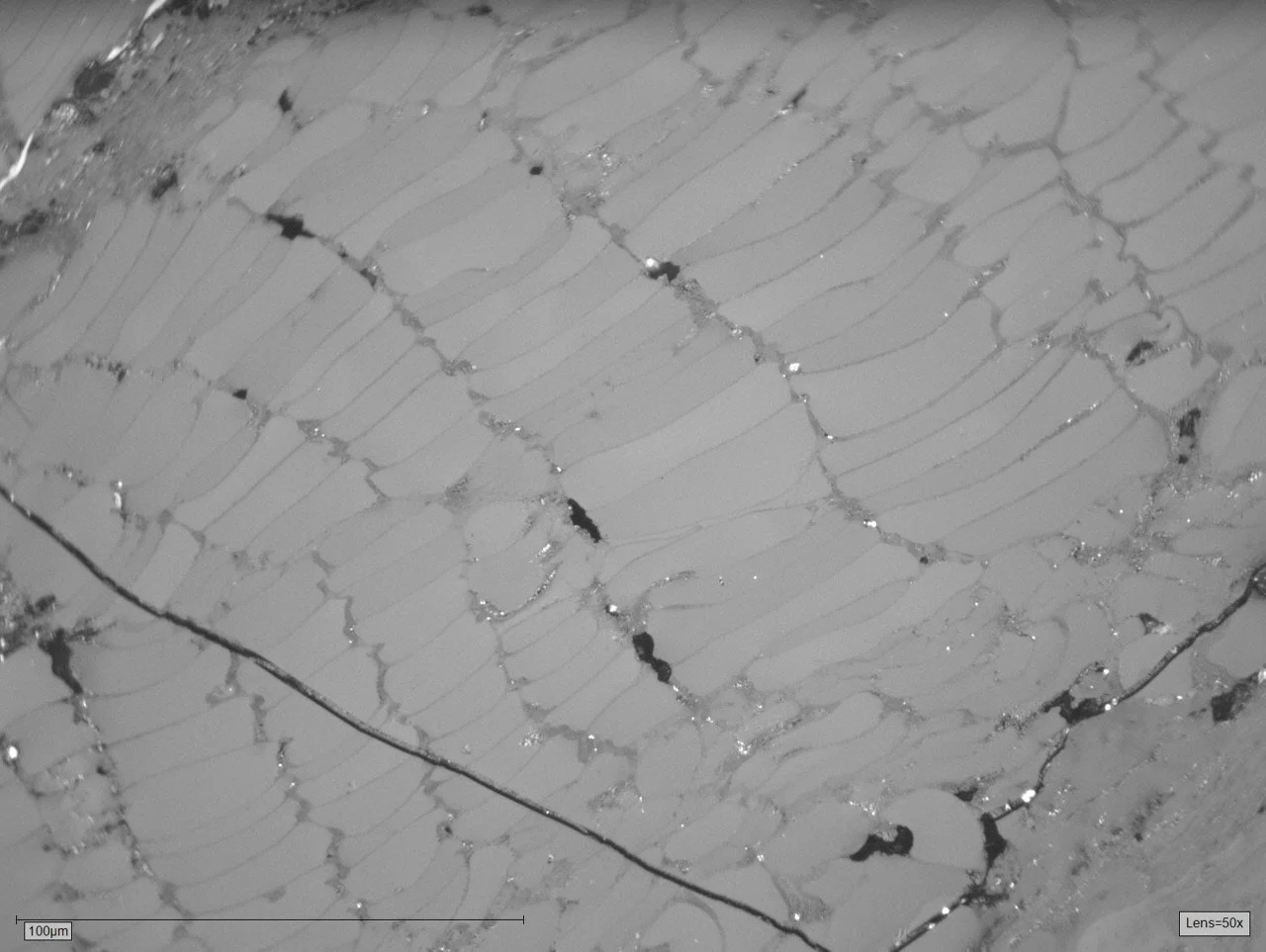
Corpogelinite typically appears as rounded to sub-rounded, smooth-outlined bodies, either as single occurrences or in groups within the same tissue. In these settings, it is bounded by surrounding macerals, commonly telinite, collotelinite or suberinite, and is recognised primarily by its mode of occurrence within former cellular spaces.
Optically, corpogelinite exhibits reflectance values comparable to, or slightly higher than, associated vitrinite of equivalent rank. It may show positive relief relative to other vitrinite macerals due to greater polishing hardness. Under reflected white light, it appears homogeneous and lacks internal structure.
Corpogelinite may originate as primary material, corresponding to cell contents (partly derived from tannins) or to secretions of the cell walls. It may also form as secondary infillings of tissue cavities, derived from humic solutions that subsequently precipitate as gels during peatification and the early stages of coalification.
Botanical affinity may occasionally be recognised, for example where corpogelinite occurs between cuticular layers of leaf tissue or as infillings of vascular tissues.
These origins can be expressed as two principal genetic pathways:
Primary formation, derived from cell contents and cell wall secretions within plant tissues, including periderm and vascular tissues.
Secondary formation, involving mobilisation of humic material in solution and subsequent precipitation within available cellular spaces
Despite their different origins, these forms are not reliably distinguishable by optical microscopy, as they converge into similar homogeneous, structureless bodies. Identification relies strongly on textural context and mode of occurrence, rather than intrinsic optical properties alone.

Scientist’s note based on:
ICCP, 1998. The new vitrinite classification (ICCP System 1994). Fuel 77, 349-358.
