Molecular and spectroscopic signatures of Miocene amber from Mizoram, India
Amber is a natural substance that originates from the resin of ancient trees. Millions of years ago, trees exuded sticky resin that captured insects, plant fragments, and other small organisms. With time, the resin hardened and fossilized under the influence of heat, pressure, and chemical changes, forming amber. Commonly yellow, orange, or brown in color, amber is lightweight, translucent, and prized for both its beauty and scientific value.
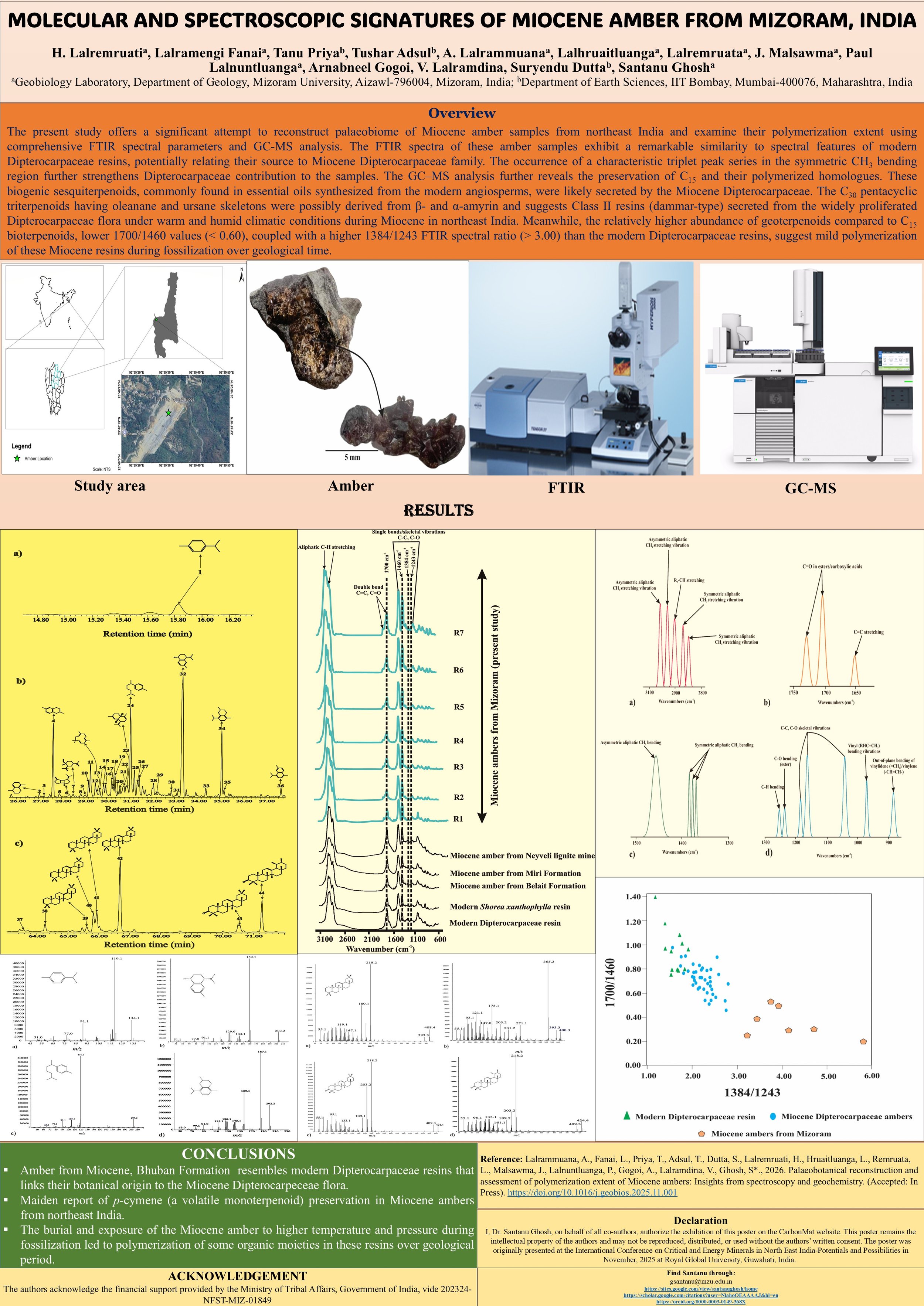
Researchers from the Geobiology Laboratory of the Department of Geology at Mizoram University, in collaboration with the Indian Institute of Technology–Bombay, discovered amber specimens embedded in sandstone–shale layers near Sairang in Mizoram, India. These ambers, dated to the Late Miocene, have provided important palaeobotanical insights. Studies of organic functional groups and biomarkers suggest that the amber originated from ancient flowering plants, particularly those from Dipterocarpaceae-dominated tropical rainforests. The findings also indicate that northeast India experienced a warm, humid climate during the Late Miocene, favoring the expansion of tropical rainforests. Additionally, the research shows that these ambers underwent moderate polymerization as a result of heat and pressure during fossilization.
Read more here:
Lalrammuana, A., Fanai, L., Priya, T., Adsul, T., Dutta, S., Lalremruati, H., Hruaitluanga, L., Remruata, L., Malsawma, J., Lalnuntlunga, P., Gogoi, A., Lalramdina, V., Ghosh, S., 2025. Palaeobotanical reconstruction and assessment of polymerization extent of Miocene ambers: Insights from spectroscopy and geochemistry. Geobios (In Press). https://doi.org/10.1016/j.geobios.2025.11.001