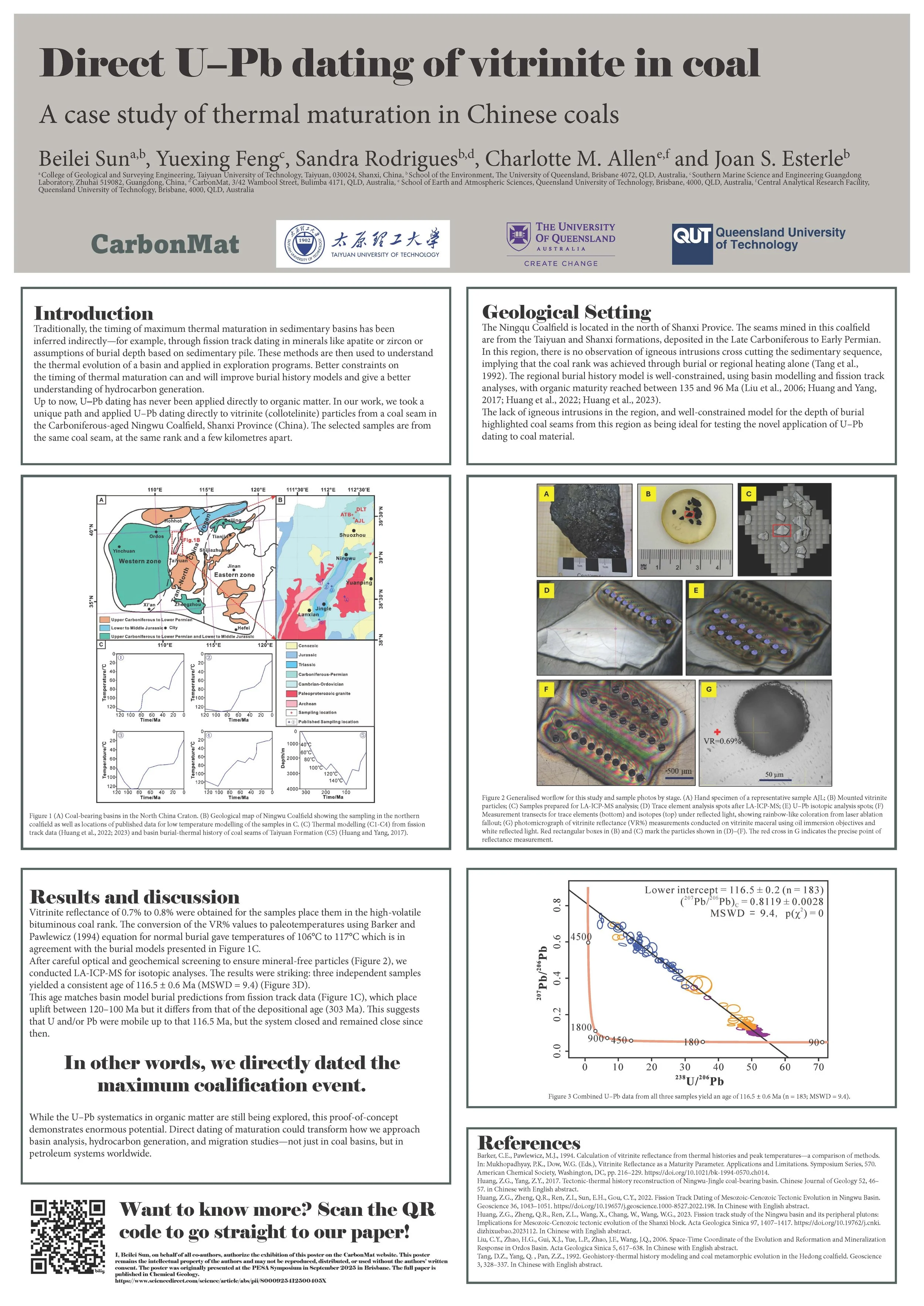
This study presents the first successful application of direct U–Pb dating of coal macerals, specifically vitrinite, to constrain the timing of coalification and peak thermal maturation in sedimentary basins. Vitrinite particles from three samples collected several kilometres apart within a Late Carboniferous coal seam in the Ningwu Coalfield (North China Craton) were analysed using LA-ICP-MS. Despite very low uranium concentrations (1–9 ppm), the vitrinite yielded consistent and geologically meaningful U–Pb ages. All samples define Discordia trends with a combined lower-intercept age of 116.5 ± 0.6 Ma, significantly younger than the depositional age (~303 Ma).
Vitrinite reflectance values (0.69–0.80 %VR) indicate maximum palaeotemperatures of approximately 106–117 °C, consistent with independent burial and low-temperature thermochronological models for the basin. The authors interpret the U–Pb age as recording the timing of maximum coalification, when uranium and lead became effectively immobile within the organic matrix and the isotopic system closed. This closure coincides with Early Cretaceous regional heating associated with tectonic reactivation of the North China Craton.
The results demonstrate that vitrinite can preserve a robust U–Pb record of peak thermal maturation, establishing direct U–Pb dating of organic matter as a novel geochronological tool for basin evolution and thermal history reconstruction
Read more here:
Sun et al., 2025. Direct U-Pb dating of vitrinite in coal. Chemical Geology 694, 123015. https://www.sciencedirect.com/science/article/abs/pii/S000925412500405X