Science at Work – 01 – Swelling Index
You receive a Crucible Swelling Number result of 7 for a run-of-mine sample, and a week later, a sample from the same seam returns a result of 4. Is it the coal, the test, or something happening at the pit? Understanding what the swelling index actually measures, what controls it, and where it falls short is essential for anyone using it in quality control or trade. This is the science behind the number.
One of the simplest tests used to assess the caking behaviour of coal is the Crucible Swelling Number (CSN) (ISO 501, 2025), also known as the Free-Swelling Index (FSI) (ASTM D720/D720M-25). It is a small-scale empirical test that records the shape of the coke button formed when coal is rapidly heated under standardised conditions. The result provides an indication of the coal’s caking capacity. The method is rapid and widely used as a routine test at mine sites, partly because it is sensitive to oxidation caused by weathering and to thermal alteration associated with igneous intrusions.
What does the swelling index measure?
Under ISO 501, the test involves heating approximately 1 g of coal ground to less than 212 μm in a crucible under predetermined conditions. After cooling, the shape of the resulting coke button is compared with a set of standardised profiles (Figure 1). For coherent buttons, the profiles are shown below (ISO 501, 2025), with values ranging from 1 to 9. Both ISO 501 and ASTM D720/D720M allow half-unit readings (e.g., 3.5 or 6.5) when a button falls visually between two reference profiles.
For non-coherent (powdery or fragmented) buttons, the value is 0.
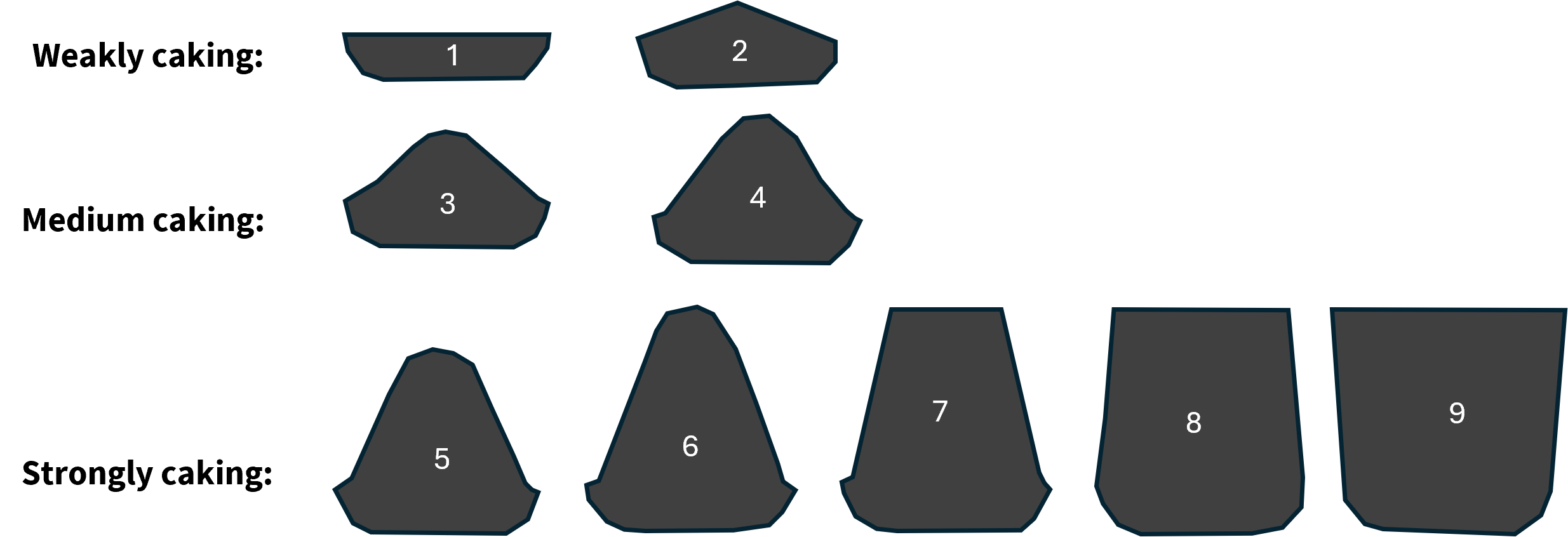
Figure 1. Standard coke button profiles used to assign the CSN value (shapes based on ISO 501, 2025).
Thus, in terms of caking behaviour, a CSN of 0 indicates a non-caking coal; values from 1 to 2 indicate weak caking; values from 2.5 to 4 indicate medium caking; and values above 4 indicate strong caking.
In commercial practice, higher CSN values are commonly associated with coals marketed for coking applications, whereas low values are more typical of thermal and PCI coals. These are broad associations rather than classification boundaries: CSN alone cannot determine a coal’s market category or its suitability for coke production.
Why does coal swell?
The swelling behaviour is a consequence of the plastic properties of coal during heating. A useful analogy is bread dough in an oven: as it heats, it softens, gases form within it, and those gases are temporarily trapped as bubbles before the structure sets. Coal behaves similarly, though the chemistry is more complex.
The process follows mainly three stages:
1. Softening. As temperature rises (roughly 300–400 °C for typical bituminous coals), the coal’s macromolecular structure begins to break down, producing a transient mobile phase known as the metaplast. The coal changes from a solid into a viscous, plastic material.
2. Bubble formation and swelling. As temperature rises towards 500 °C, the coal releases volatile matter, including hydrogen, methane, carbon monoxide and tar vapours. Because a mobile plastic phase is present, some gases become trapped, forming bubbles that expand the coal mass, much as gas causes bread dough to rise.
3. Resolidification. At higher temperatures (around 450–550 °C, depending on the coal), the metaplast undergoes further reactions and solidifies into semicoke, locking in the expanded bubble structure. The final button shape, and therefore the CSN/FSI value, reflects the balance between gas generation, metaplast viscosity and the timing of resolidification.
In essence, CSN provides a quick visual record of this three-stage process. A coal with low fluidity may generate gas but remain too stiff to expand substantially. At the other extreme, a highly fluid coal may allow gas to escape before the structure resolidifies. Strong swelling therefore requires a suitable balance among gas generation, plasticity and resolidification, which is closely linked to rank and maceral composition.
In ISO 501, the test continues to a final temperature of approximately 820 °C, well above the plastic range. This completes carbonisation sufficiently to stabilise the residue and produce a coke button that can be compared reproducibly with the standard profiles. The final test temperature should therefore not be mistaken for the temperature at which swelling occurs.
What controls the swelling index?
The caking capacity of a coal is primarily governed by three parameters: rank, type and grade.
Rank
Rank is the degree of coalification, or thermal maturity, that the organic matter has undergone after burial. It is commonly expressed using vitrinite reflectance (Rmax% or Rr%), volatile matter (VM, daf) or carbon content (C, daf). Low-rank coals, such as sub-bituminous coals, are too low-rank to develop significant fluidity. High-rank coals, such as semi-anthracite and anthracite, have undergone such extensive structural ordering that their macromolecular network is too rigid to soften. Intermediate-rank coals within the bituminous range, broadly corresponding to approximately 0.6–1.8% Rr, possess the greatest plastic behaviour and therefore tend to produce the highest CSN values. The strongest caking behaviour commonly occurs around 0.85–1.4% Rr, with peak values often in the medium-volatile bituminous range. Understanding where a coal sits on its rank stage is the first step in predicting its swelling behaviour.
Type
Type refers to the maceral composition of the coal, the organic components visible under reflected light microscopy. For coking coal assessment, the key contrast is between vitrinite and inertinite, with liptinite usually present in minor amounts.
Vitrinite melts during carbonisation and is the primary contributor to the metaplast and therefore to swelling. At sufficiently high rank (anthracite, see above), vitrinite loses its thermoplastic behaviour and contributes increasingly as a non-plastic component.
Liptinite is hydrogen-rich and produces abundant volatile products, but its effect on swelling and coking is not always positive. The response depends on rank, liptinite abundance, maceral type and the surrounding vitrinite matrix. At high concentrations, excessive volatile generation or insufficient binding matrix can work against the formation of a coherent coke structure.
A common oversimplification is to treat all inertinite as completely inert during carbonisation. Some lower-reflecting semifusinite and related inertinite particles can show partial reactivity, whereas high-reflecting inertinite generally remains non-reactive. Reactivity therefore depends on both maceral identity and reflectance, not simply on total inertinite content. The distinction between reactive and inert inertinite matters when interpreting CSN alongside petrographic data, as two coals with the same total inertinite content can behave very differently in the crucible depending on the reactive/inert macerals content.
The diagrams from Pearson (1980) and Shibaoka and Bennett (1976) capture the roles of composition and rank very well (Figure 2). For a given rank (Rmax% or carbon content), CSN/FSI values increase with decreasing inertinite content or increasing vitrinite content. For a given composition, however, the iso-swell lines show a characteristic boomerang shape, with maximum swelling at intermediate bituminous rank. Despite some outliers, these diagrams illustrate the influence of rank and type on the swelling properties of some Bowen Basin coals. The sample data plotted on the diagrams come from the publicly available The Queensland Coals (Mutton, 2003), also known as the Green Book.
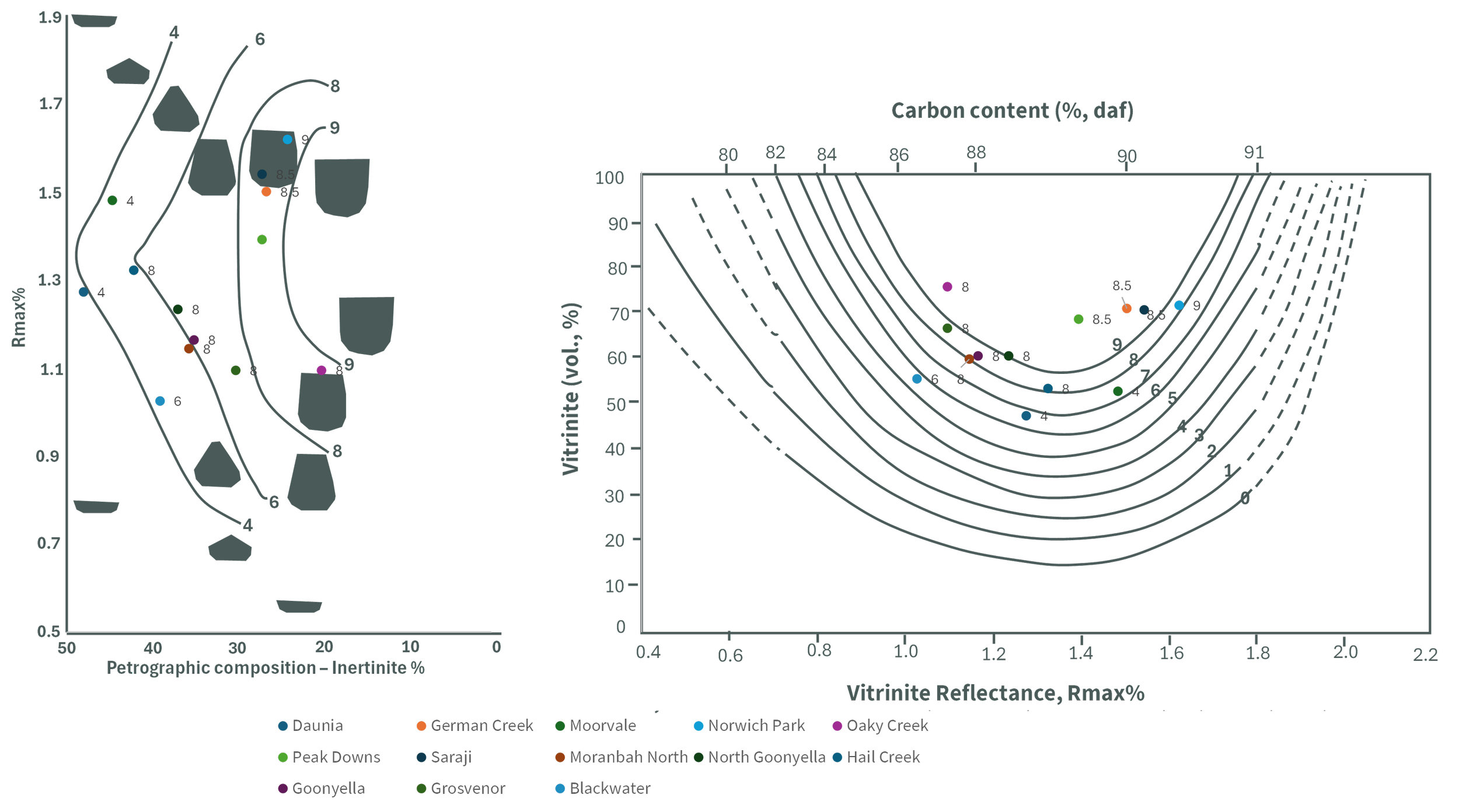
Figure 2. Iso-swell lines (FSI) adapted from Pearson (1980) (on the left) and iso-swell lines (CSN) adapted from Shibaoka and Bennett (1976) (on the right). Sample points show data reported by Mutton (2003) in The Queensland Coals (the Green Book). Labels show the CSN value reported for each sample.
Grade
Grade in coal quality refers to the proportion of inorganic material associated with the coal and is commonly assessed using ash yield. Ash is the residue produced after combustion and is related to, but not exactly the same as, the original mineral-matter content. Increasing ash yield commonly reduces CSN through dilution of the reactive organic fraction. Minerals may also affect gas release, plastic phase behaviour and the structure of the resulting button, so the effect is not always purely one of dilution.
Why does oxidation reduce swelling?
The CSN test is particularly sensitive to oxidation, which is why it is useful as a weathering indicator at mine sites. But why does oxidation lower the swelling index?
When coal is exposed to oxygen through weathering at the surface or oxidation during stockpile storage, oxygen-containing functional groups and cross-links form within the coal’s macromolecular structure. Think of it as adding extra stitching to a net: the individual strands can no longer move freely. These reactions stiffen the coal structure, reducing its ability to soften and form the fluid metaplast necessary for swelling. The plastic phase becomes shorter, less fluid or absent entirely. The result is a lower CSN value or, in severe cases, a non-coherent button (CSN = 0).
This makes CSN a sensitive, practical indicator of possible oxidation. A decline in CSN along a seam may indicate oxidation, but it can also result from changes in rank, maceral composition, mineral-matter content, sample preparation or storage. Near an igneous intrusion, reduced swelling may reflect rapid rank increase and devolatilisation rather than oxidation itself. CSN alone therefore cannot distinguish weathering from other causes of low swelling, such as an inherently inertinite-rich composition.
Coal swelling properties can also deteriorate during laboratory handling. Exposure to air, changes in moisture and size reduction can alter the coal’s properties. To minimise these effects, samples should be sealed, retained at the largest practical top size, stored under suitable cold conditions and analysed as soon as possible.
CSN is a proxy, not a standalone rheological measure
This is an important practical point for anyone using CSN in quality control or trade: the CSN test gives a single number that correlates with, but does not replace, the more quantitative rheological tests used in coke oven blend design.
The Gieseler plastometer (ASTM D2639 / ISO 10329) measures maximum fluidity in ddpm (dial divisions per minute) and the temperature range of the plastic phase. The Audibert-Arnu dilatometer (ISO 349) quantifies the degree of contraction and dilation during heating. Both provide information that CSN cannot: the duration of the plastic window, the temperature at which fluidity peaks and whether a coal’s behaviour will be compatible with other blend components in a coke oven. Two coals with identical swelling indices can behave very differently in the oven.
For blend prediction, actual carbonisation tests on the prepared blend or, at minimum, Gieseler and dilatometer data for each component are necessary. A coal with a low CSN may not produce good coke on its own, but this does not disqualify it from inclusion in a blend with coals that have superior caking properties.
What should you investigate when the result changes?
Anomalous CSN results are common in field programs and can be among the most informative data points when interpreted correctly. A systematic check should consider the following:
First, consider the reproducibility of the test
It is important to be realistic about the precision of the CSN test. ISO 501 requires replicate determinations and specifies the acceptable range between them. Because the result is assigned by visually matching the coke button to standard profiles, differences of half a CSN unit may reflect the resolution of the method rather than a meaningful change in the coal. Larger differences require investigation of sampling, sample preparation, storage and test execution.
Confirm the result. Check whether the replicate determinations were consistent and whether the coke button was assigned to the correct profile.
Check the sample. Confirm that both results represent comparable material from the same seam interval or product stream. Sampling is everything.
Check preparation and storage. Compare particle size, moisture condition, storage time and exposure to air before analysis.
Check rank, type and grade. Determine whether vitrinite reflectance, maceral composition or ash yield changed between the samples.
Consider alteration. Look for weathering, proximity to an intrusion or other signs that the coal has been thermally altered or devolatilised.
Use complementary results. Interpret CSN alongside petrography, proximate analysis, Gieseler fluidity, dilatation or carbonisation data, as appropriate.
Two geological examples illustrate why this broader context matters:
Unexpectedly low CSN near igneous intrusions. Contact metamorphism caused by dykes or sills can raise local rank rapidly and reduce or eliminate thermoplastic behaviour. Near the contact, the coal may be devolatilised to the point where it behaves as a natural semicoke. In a profile, CSN values may decrease towards zero as the intrusion is approached.
Inertinite-rich coals. Low CSN values should not automatically be interpreted as oxidation. Coals containing abundant non-reactive inertinite may lack sufficient plastic material to form a strongly swollen or coherent button, even when the sample is fresh. In such cases, knowing the maceral composition is particularly useful when interpreting the CSN values.
A change in CSN from 7 to 4 is therefore too large to dismiss without investigation, but the swelling index alone cannot identify the cause. The result must first be confirmed and then interpreted against the sampling history, coal properties and geological setting.
Summary
The CSN test is deceptively simple: one gram of coal, a crucible, a flame and a chart. But the number it produces reflects a series of physical and chemical processes: the softening of the coal matrix, the generation and trapping of gas bubbles, and the resolidification of the expanded structure. The result is controlled mainly by rank, maceral composition, mineral matter, oxidation state and sample condition, and it must be interpreted within that framework to be useful.
Used correctly, as a rapid screening and monitoring tool interpreted alongside petrographic and proximate data, CSN remains one of the most practical tests in the coal-quality toolkit. Used without that context, it can mislead. Knowing the difference is science at work.
References
AS 1038.12.1, 2002. Coal and coke – Analysis and testing – Higher rank coal – Crucible swelling number. Standards Australia.
ASTM D720/D720M-25, 2025. Standard Test Method for Free-Swelling Index of Coal. ASTM International.
ISO 501, 2025. Hard coal — Determination of the crucible swelling number. International Organization for Standardization.
Mutton, A.J., 2003. Queensland Coals - Physical and Chemical Properties, Colliery and Company Information. Department of Natural Resources and Mines Bureau of Mining and Petroleum, Queensland, Australia. 116 pages.
Osborne, D. (Ed.), 2023. The Coal Handbook, Volumes 1 and 2, 2nd ed. Elsevier.
Pearson, D.E., 1980. The quality of Western Canadian coking coal. Coal and Mining Technology. www.coalpetrography.com/library/pdf/quality.pdf
Shibaoka, M., Bennett, A.J.R., 1976. Use of swelling index profiles of the Buli Seam in New South Wales, and their general application in coalfield geology. Fuel 55, 99-104.
Speight, J.G., 2012. The Chemistry and Technology of Coal. 3rd ed. CRC Press. 845 pages.
