Guest Series - 06 - Publishing: Notes from the perspective of a reviewer by Jim Hower
“Tell me something. Do your editors edit the hell out of what you write or do you just not write anything worth reading in the first place?”
As told by a bar patron to Walter Tunis, Contributing music critic, Lexington (KY) Herald-Leader (13 November 2020).
In just two sentences, the unnamed bar patron summed up their perceptions of editors and writers from the perspective of a reviewer or a non-reviewer reader. While some of us have been editors and even more of us have written papers for journals, it is a reasonable bet that most of us have reviewed many more papers than we have written or edited. Therefore, other than saying that editors are overworked and are not fully appreciated by their authors or their journal overseers (a role not necessarily equivalent to an employer, as many editors do not get any compensation other than free access to an open-access journal and very few are actually employees of the publisher) and that most authors, in spite of the mistakes that fluster both reviewers and editors, are honestly trying to get their hard-won research into the hands of appreciative readers who might one day build their own studies on that foundation. I will focus this essay on the occasional frustrations of a reviewer.
The first rule of being a reviewer is to remember what it is like to get reviews of your own paper. Some reviews are good and some are bad, but the ones that are the best are the critiques that guide you to the improvements necessary to produce an acceptable paper. Be that reviewer. Do not be the reviewer who delights in cynical and hypercritical comments. Do not be the reviewer who leaves marginally (or totally) “not-safe-for-work” comments in the margins. One way to “be that reviewer” is to treat every review as if you are not anonymous. Personally, remembering the experience of getting scathing anonymous comments and getting the remarks from the tie-breaking third reviewer specifically selected to justify rejecting the paper (for example, a volcanologist selected to review a paper on lignite petrology and palynology), I prefer to identify myself to the authors.
As a reviewer, other than a paper that is poorly written and/or has an irredeemably flawed experimental design and questionable implementation and interpretation of the research, what are the factors that stand out in my mind?[1]
First, I look at the methods. Not all flawed experimental designs are obvious and not all vaguely written designs are wrong. If there are clues that, for example, the size fractions for petrology and chemical analysis are not representative of each other and of the whole coal, then the author needs to check the clarity of the writing and the legitimacy of the experimental design. While the former is easily corrected, the latter dooms the experiment and the manuscript. Yes, there are situations where a double-screened sample is necessary for the experiment, but such situations need to be clear. If the method is vague, I ask for clarification.
As a side note, a flaw of AI screening of manuscripts is that it might identify precise and correct procedures as text duplicated from previous papers. In the description of analytical procedures, there is a practical boundary between “precise and correct procedures” and the altered descriptions that might pass AI’s strict eyes. “Precise and correct procedures” are preferred and, indeed, altered descriptions might dictate incorrect procedures.
Second, while seemingly trivial, a sloppy reference list with misspellings, incomplete references, and, in the worst case, fictional references is a first clue that the background research and the overall design of the experiment might be sloppy. In an example shared with me, I know that “Hower, J.C., 1999. Halite in Coal: Significance and Implications. Int. J. Coal Geol. 40(2), 89-107” is not one of my papers. But should I doubt my memory and my CV when Google’s AI overview tells me that “this pivotal 1999 paper by James C. Hower examines the occurrence, origins, and operational impacts of halite and related chlorides in coal”?[2] Basically, a submitted draft of a paper should be as complete and thoroughly checked as if it is the final draft prior to publication. An AI or EndNote rendition of a reference list is not complete in itself; such lists need as much, if not more, editing as if you typed every reference individually. Never give the reviewers and editors a reason to doubt the thoroughness and honesty of your effort.
Finally, for now, figures should clearly represent your work. For the (somewhat) color-blind eyes of a veteran (another way of saying old) reviewer, tiny fonts and/or undiscernible color combinations mean that the message of the figure is lost. If you cannot find the red caption on the black background and if a black & white photocopy cannot be read, then the colors need to be revised.
Accepting the invitation to review is a matter of trust between the editor, reviewer, and the author who might never learn the name of the reviewer. Why trust? The editor is looking for a smooth process; that implies either a prompt acceptance or an equally prompt decline. Ignoring the invitation puts both the editor and the author in a bind; acceptance or revision or rejection hinge on the action of the reviewer. In some cases, the graduation of a student could be impacted by an unnecessarily slow process. Basically, as authors, we expect prompt process (with the understanding that “prompt” may still imply a few months); as reviewers, we should grant the same courtesy to other authors.
How long one spends on a review is, of course, quite variable. A brief, well-written manuscript might require a few hours. A second review of a paper that required only minor changes might take less time. On the other hand, a problematical manuscript with grammatical issues and obscure references will take more time. Even a well-written review paper approaching or exceeding 100 pages will take time.
Through it all, we must appreciate that the process is prone to flaws. Good papers are rejected, flawed papers are accepted (that is why discussions and replies are part of journals), and groundbreaking papers may be overlooked at first. Perhaps the most famous example of the latter was the outright rejection of the seminal paper on lasers; the journal editor never even let it get to the reviewers.[3]
Early in my editing career, one of the editorial board members told me that the job of the editor was to guard the guards. Reviewers are the first line of guards in the process of publishing a paper. Reviewers will disagree with each other. Editors have the responsibility to sort through the comments of reviewers and determine where the decision lies within the range of opinions. Within the range of opinions, it is important for the reviewers to not only see the correctable flaws within a good paper but also see the potential within a difficult paper. Both ends of the spectrum are difficult. Both ends of the spectrum are essential in the publication of the best research.
[1] Other than the standard books on writing, for example, Strunk and White’s Elements of Style (various editions), scientific writers should look at the series by Peter Thrower:
Thrower, P. A. (2007). Writing a scientific paper: I. titles and abstracts. Carbon, 45(11), 2143-2144.
Thrower, P. A. (2008). Writing a scientific paper: II. introduction and references. Carbon, 46(2), 183-184.
Thrower, P. A. (2008). Writing a scientific paper: III. experimental. Carbon, 46(8), 1113-1114.
Thrower, P. A. (2010). Writing a scientific paper: IV. results and discussion. Carbon, 48(10), 2675-2676.
Thrower, P. (2011). Editorial: Writing a scientific paper V - language. Carbon, 49(15), 4957-4960.
For a non-scientific and lighter look at the subject, Stephen King’s On writing is an interesting diversion
[2] The situation recalls the Chico Marx line from the 1933 movie Duck Soup: “who ya gonna believe, me or your own eyes?”
[3] https://press.uchicago.edu/Misc/Chicago/284158_townes.html
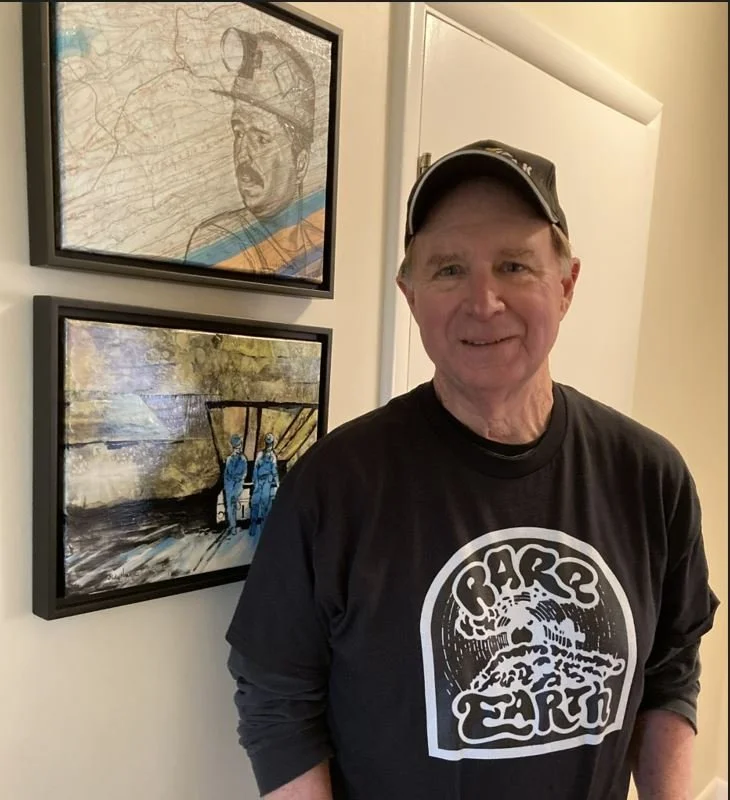
About the Author
Jim Hower received his BA, MS, and PhD degrees in geology from Millersville University, Ohio State, and Penn State, respectively. He has been a scientist at the University of Kentucky’s Center for Applied Energy Research (CAER) since 1978 and has been an adjunct professor and, later, a Research Professor in the University of Kentucky Department of Earth & Environmental Sciences since 1981 with a research focus on a broad range of topics within coal and fly ash petrology and chemistry. As of mid-2021, Jim retired from the university, but, finding that retirement is a speedbump and not a wall, he remains active at the CAER and elsewhere. He has authored more than 575 papers in more than 140 journals and books. He was the editor of International Journal of Coal Geology and Coal Combustion & Gasification Products for 10 years each. Jim has received the top awards from The Society for Organic Petrology, International Committee for Coal & Organic Petrology, and the Geological Society of America’s Energy Geology Division. In addition, he was a fictional coal geologist in Karen Rose Cercone’s 1999 mystery novel, Coal Bones.
https://www.linkedin.com/in/james-hower-819b3b16/
https://uknow.uky.edu/professional-news/caer-s-hower-co-authors-pioneering-coal-book
https://www.amazon.com.au/Coal-Bones-Karen-Rose-Cercone/dp/0425166988
